
I’m trying to wake my Muse up and will attempt to revive this poor old blog. I don’t even know my password to get into WordPress, but somehow my computer had it stored. First page I’m going to add is about health issues, but it may stay as a private place for me. The others I look forward to eagerly continuing my early journeys – reviewing books, adding stories to and from my memoir, teaching gun stuff, my family, my garden and more! Stay tuned world, I think I’m back!
Reviving the Muse
Posted by Range Officer Rhonda on June 1, 2016
Posted in Uncategorized | Leave a Comment »
If Trees Give you Peaches – make Pie!
Posted by Range Officer Rhonda on July 18, 2011
This is the Peach Pie I made today with my peaches from the orchard. I haven’t gotten much fruit or veggies from the garden this year as we are in a severe drought.
For rain this year [2011] we have gotten first, .01 inch; then .66 inches, then another .30 inches last week followed by a trace we couldn’t measure. Let’s see, my house so far this year has gotten a total of .97 inches – let’s just round it up and say one whole inch! Wow – that’s bad. I think we are about 30 inches behind and nearly everything in my yard is dead – including the grass. We have cracks and holes big enough to swallow dogs and squirrels. This is probably the worst we’ve seen in 15 years, and it follows a bad drought from the prior two years.
Posted in Uncategorized | Tagged: drought, peaches, pie, Texas drought, texas peaches | Leave a Comment »
That’s Not My Job
Posted by Range Officer Rhonda on February 14, 2011
Time for a little venting here. Just a little.
One of the things I really hate to hear is someone, supposedly in authority, who spews the phrase out to me that “That’s Not My Job”. Grrrr I went through this today when I tried to be a good citizen and report that somebody had dumped a dead deer in my driveway.
First of all, for many of you that don’t know me well, one of my jobs is a VOLUNTEER, not paid, Instructor & Area Chief for Texas Parks & Wildlife. Now, I guess it is conceivable that one of my neighbors thought I would appreciate this gift of a young deer carcass. NOT. It is illegal for anybody to take or use any part of an animal that was ‘harvested’, aka, make dead, by a motor vehicle. Why someone would think I would want this gift is anyone’s guess.
So I made some calls. First was to animal control because they are in charge of catching loose animals & wildlife or helping you trap and relocate varmints. THAT’S NOT MY JOB, they say. OK, who then? Well, you’re supposed to call the police so they can write up a report for your insurance. But the animal was there – no vehicle. So the police? THAT’S NOT MY JOB. So who do I call? The garbage/waste management people. You got it – THAT’s NOT MY JOB – we aren’t allowed to touch dead animals. OK, so who do I call? Let me connect you with the streets department of your local utility company – it’s THEIR job. So what do they say after I select #3 and #1 and #####…’leave a message’.
Eventually, after many calls, I did find out it was the street & highways department that is responsible – if the animal is in a street. [It was in my yard]. Well, the animal moved mysteriously a couple yards into the street and I suspect a certain person or two put a bug in somebody’s ear…and the deer is finally gone.
It shouldn’t be so complicated for a person to handle a simple little problem. I can see why so many people take the law into their own hands and just handle the problem. I don’t condone this type of action, but if I hear that phrase one more time…..
Posted in Daily Life | Tagged: handling dead deer, Road kill, take the law into your own hands | 5 Comments »
What to do when it freezes in Central Texas – make soap!
Posted by Range Officer Rhonda on February 4, 2011
Just a short post about the cold weather. We’ve been over 70 hours where temperatures haven’t reached above freezing; not a common occurence in Central Texas. First thing I noticed this AM after our first real snow this year is that I was woken up not by my dogs whining to go out – but by something pecking on my foot. What the ???
My husband, who doesn’t like to cage animals, decided our last remaining chicken [the flock being devastated by varmints] needed to be in the house. We do have a nursery cage for young or injured creatures, but he must have heard the phrase I recently heard on a commercial about ‘Free Range House Chickens’. Chatty Cathy, our Buff Orrington, became a free range house chick this morning and discovered me all snug in my blankets, so proceeded to wake me up so she could talk to me.  Silly chicken follows people and dogs everywhere and doesn’t like to be alone, especially after being attacked and mauled by a racoon and a possum [who now rest in animal heaven]. Me, being the cold hearted person I am, well, I don’t feel like being a dirt floor poor farmer that sleeps with her livestock – I threw the chicken back outside. She can come back in tonight and sleep in a cage though.
But that’s not what I wanted to write about today. Lately I’ve beentalking about making soap – the old fashioned way. With the apple, oak and other hard woods that we burn in our fireplace and Bar-B-Q smoker, I now have plenty of ash to prepare a batch of lye for soap making. For today, I’ll talk mainly about the wood. I’ve been helping make soap since the early 60’s – starting when I was old enough to stir the vat for Grandma Pearl. Kerchief tied over my face and Grandma’s long thick rubber gloves on my hands and an old apron over my clothes, I dutifully, but not happily, felt the burn in my shoulders as I stir the big paddle in the kettle. Grandma was smart and good about making soap & lye, but I never knew the science behind it. The first step, of course, is to make the lye. It sounds like an easy job, even easier now since you can buy it straight from the store! It all starts with the wood. And the tools.
Wood for lye making should always be from hard wood trees, such as Oak or fruit trees – any tree that flowers and has fruit is generally a hard wood. Grandma says it is harder because the wood is more fiberous and not so wet? What the heck does that mean? Trees that are more like evergreens and bear a cone tend to be more ‘wet’ and soft. That’s not to say there aren’t soft hardwoods or harder softwoods..There actually is a science involved in this, but let’s keep it simple here. Use hard wood. Look it up on the internet if you are not sure if you have hard or soft wood. If you have mixed ashes, start over until you know your ashes are all hard wood generated. Applewood is my favorite and since I lost an apple tree last year to the drought, I have perfect wood.
Once my ashes have cooled enough to use, the best way to make lye is to have an old wood barrel with a hole cut in the bottom and a cork inserted tightly. I set this up on some cinderblocks, leaving a space large enough to put a bucket or pan underneath. Taking some clean hay or buffalo grass, I place a layer of fodder about 3 inches deep in the bottom of the barrel. Some people use other types of barrels, from metal to plastic, but they react to the lye produced, so I don’t recommend them. ooops – taht piece of advice is a little out of place, isn’t it?
OK. Hardwood ash, about a 5 gallon bucket full. Check. Wooden barrel propped up on cinder blocks. Check. Bottom lined with fodder – CLEAN fodder. Check. Pour ahses in barrel. Ahhhh….water. You want SOFT water. I can’t use the water from my house, so I use the rain water I collect in my rain barrels. I put in enough water to cover the ash. It will take nearly a day for the ash cloud to settle down. Don’t stir it! Let this mixture set for about three days with a cloth over the top [or board] so that nothing joins the mixture. After 3 days, you can take an egg or raw potato and gently drop it in. If about a quarter sized pieced is showing as the egg or potato tries to float, then your lye is done. If they don’t float, add more ash and soak an additional day until you get the desired result. When this step is complete, pull the plug at the bottom after placing a mesh screen over your bucket, and drain into your bucket. Store covered in a cool place, but it’s best used fresh.
My next piece will talk about what you with the ashes when you are done and what to add to the lye to make soap. But I can’t do that until I get some fresh hog fat this weekend and fill the freezer with meat. Just as a note, we had scraped our ashes from the grill into a metal bucket beside it. Then it rained. And the ashes sat for a week. I knocked into it and splashed some on the porch. Guess what? I now have the cleanest cement pad around the smoker! This lye batch made itself with no help from me!
Posted in Daily Life | Tagged: Free range chickens, Hardwood trees, ice storms, making lye, making soap | 1 Comment »
Sunset Musings
Posted by Range Officer Rhonda on January 9, 2011
The past few days have shown us some gorgeous sunsets. My son and I grabbed our cameras and shot a few pictures. I will inlcude one for your enjoyment.
These sunsets remind me of our family watching the sunset each night, a standard tradition whether we were at our home in Happy Rock, USA, at the Southern Missouri Ozarks’ lake Pomme de Terre or watching as a blazing ball slipped over the edge of the wall of our compound in the Middle East. The best was perhaps watching the sun dip into the Red Sea after a day on the beach, although we seldom lingered there past dark.
I’ve always been a sky watcher, during my Sky Diving days I would spend most of my ground time looking up. During my Scuba days, I would watch the sun’s rays pierce from underneath the water; like golden spears reaching down to touch me, or watch the moon trail it’s arrowing path across the waters, inexorably drawing the eyes along it’s path. Everywhere and every when, I am a sky watcher.
When my mother and I would sit and watch the sky fall to darkness, those were the times we would talk. At first, it would be just about how our day went, or with Grandma, we’d hear tales of family before, crops, weather and animals. From an early age, mom taught me to focus my thoughts by watching the sky, settling my mind at the end of the day. Dad would get involved too – describing how the contrails were formed as they lay a tic-tac-toe pattern onto the sky’s page.
Now, when I look at the sky, I still see fanicful animals and dazzling displays of color as the evening sun dresses up the end of each day. The first star of the night still has the power to make me wish upon a star. My wish this evening is that my mother is happy in heaven and as she gazes down upon me, watching the sky, she knows I am thinking of her.
Tomorrow, January 10th, would be my Mother’s birthday were whe still alive. Watch for my post over on the new blog, One Woman’s Day. It can be found at: http://www.onewomansday.wordpress.com 
Posted in Dad & Family | Tagged: sunset pictures, Texas sunset | 3 Comments »
Repurposing
Posted by Range Officer Rhonda on January 3, 2011
This is slightly off my normal post, but I wanted to share a picture with everyone. Often, when my husband or I are off in the woods somewhere, we find interesting pieces of wood. I can’t tell you how many of these make their way home with us because we want to ‘make’ something. My current one is a root that with a little work could look like a deer feeding. It’s cute.
For Christmas this year, my husband took a piece of wood he had found and with a little skill and a lot of time, turned it into a beautiful living room table for his brother. The base is made from a huge cedar root. In addition to the two cedar root ‘legs’, there is a third piece that he turned into a companion plant stand, but I didn’t get a picture. This table is a slab of Black Walnut and it is just as interesting on the bottom [with more bark showing underneath] as it is on the top.
Now, if only he [my husband] could do this kind of work all the time and get paid for it!
Posted in Uncategorized | 6 Comments »
Remembrances
Posted by Range Officer Rhonda on January 2, 2011
I just finished editing and submitting a piece for a new blog, One Woman’s Day, which can be found at http://onewomansday.wordpress.com
My piece is [hopefully] going to appear on this new blog on January 10th, which is/was my mother’s birthday. While writing it, I started to dig through a box of old photos my Dad had given me so that I could find pictures of my Mom and her good friend, May Riley. I’ll post some of those pictures here. 
During the writing of this piece, I was assailed by many memories of what our family and many families dealt with while forming our family groups in the Middle East. As many of you have read before, I grew up in a combination of the Midwest [Missouri Ozarks], a Catholic boarding school [Mt. St. Scholastica Academy in Atchison, Kansas] and the port town on the Red Sea of Jeddah, Saudi Arabia. My memories of Jeddah and the familes we met are what I want to write about today, just a bit, so that you can understand a little more of the bond my Mom formed with her friends there.
Back in the early 1960’s, Saudi Arabia was a growing third world country in the Middle East that was struglling to assimilate itself into a Western veneer. They had found oil and were trying to find ways to improve not only their struggling, desert economy but their presense as a power in the great old planet we call Earth. A country ruled by Muslims was trying hard to obtain their goals of economic progress while not being taken advantage of by Westerners nor tormented by their Muslim breathren. It was and still is a work in progress. Back then, in the 60’s, American and European workers, with their families, were being brought into that country to help build and train in a variety of industries, including oil exploration and commercial travel.
Where the women come into play was, I think, an attempt to keep the men there longer and keep them happy. While an adventure for many, those western women such as my Mom had a difficult time adjusting to the status of being just ‘an accesory’ for the men. The dress, the language, the freedoms enjoyed, the food, religion and families were basically left behind and it was hard for these outspoken, sometimes lessly clad [not necessarily ‘scantily’] independant women find themselves having to cover their skin, unable to drive and definitely not speak their minds, They became non-people. And so..they learned to adjust. They learned to ‘Make Do’. And they learned to form new family groups to lean on, laugh with and share – replacing, but not forgetting, the families they left at home. Into this hodge podge of mixed families, my Mom formed many new friendships and one of those nearest and dearest [although not the only one] to my Mom was quirky, beautiful woman named May Riley with her English upbringing and accent.
That’s all I will write about today, but in this month of my Mother’s birth, I wanted to remember her with a few thoughts and pictures on my blog.
Posted in Dad & Family, Middle Eastern Stories | Tagged: Jeddah, Middle Eastern stories, Saudi Arabia | Leave a Comment »
Happy New Year!
Posted by Range Officer Rhonda on January 1, 2011
Many people start the New Year out by [after trying to cure the hangover] getting together with family and friends and honoring time proven traditions of eating various types of food. In my past, the men would retire to the ‘Living Room’ to watch some game or to the garage to ooh-ahhh over some new tool or engine or project. If the weather was nice, the kids ran outside to play or perhaps would go down to the basement to start a marathon game of Monopoly.
With the turkey, goose, duck, ham or brisket in the oven, the women in the kitchen would settle in to chatter. I would often sneak in to listen if the weather was cold outside because I didn’t like having to entertain my younger cousins and I was too young to join in with the older kids. I was stuck in the middle with nobody my age. So I absorbed the kitchen lore. Two things I want to talk about from kitchen lore are Whomp ’em breads and Powdered milk.
On the Whomp ’ems – I mean the canned biscuits and such. We seldom had these available to us when we lived in the Middle East but in the late 60’s & early 70’s, these are all my mom would use. And these may be all most people really know, I’m sad to say. We called them Whomp ’ems because to open them, you would peel the outer layer of paper off, find the diagonal slit, then whomp the container on the cabinet to open. Often, you couldn’t just tap lightly, you had to give it a good hard blow – or two! Then, packagers moved on to telling people to insert a spoon in the crack to pop them open. Most modern tubes don’t require a whomp and don’t pop and spill the dough out – boring! However, one particular brand of cinnamon rolls recently gave me a great smile.
My son wanted to make some cinnamon rolls and I bought him a can of the kind you pop open and heat up instead of teaching him how to make them from scratch. He seldom, or never, saw me open one of these Whomp ’em-like containers so I instructed him how to peel the paper back and then tap the seam on the edge of the counter. When this can opened with an exceptionally loud POP [for this time period, anyway], he screeched and dropped the container on the counter like a hot potato. I just laughed and laughed and he was all indignant, ‘Why didn’t you tell me it would do that??’ I’m grinning now with the memory. And the cinnamon rolls were great. I imagine my son will use more Whomp ’ems and store bought food when he goes out on his own, but he will know how to cook and fortunately he loves almost all veggies.
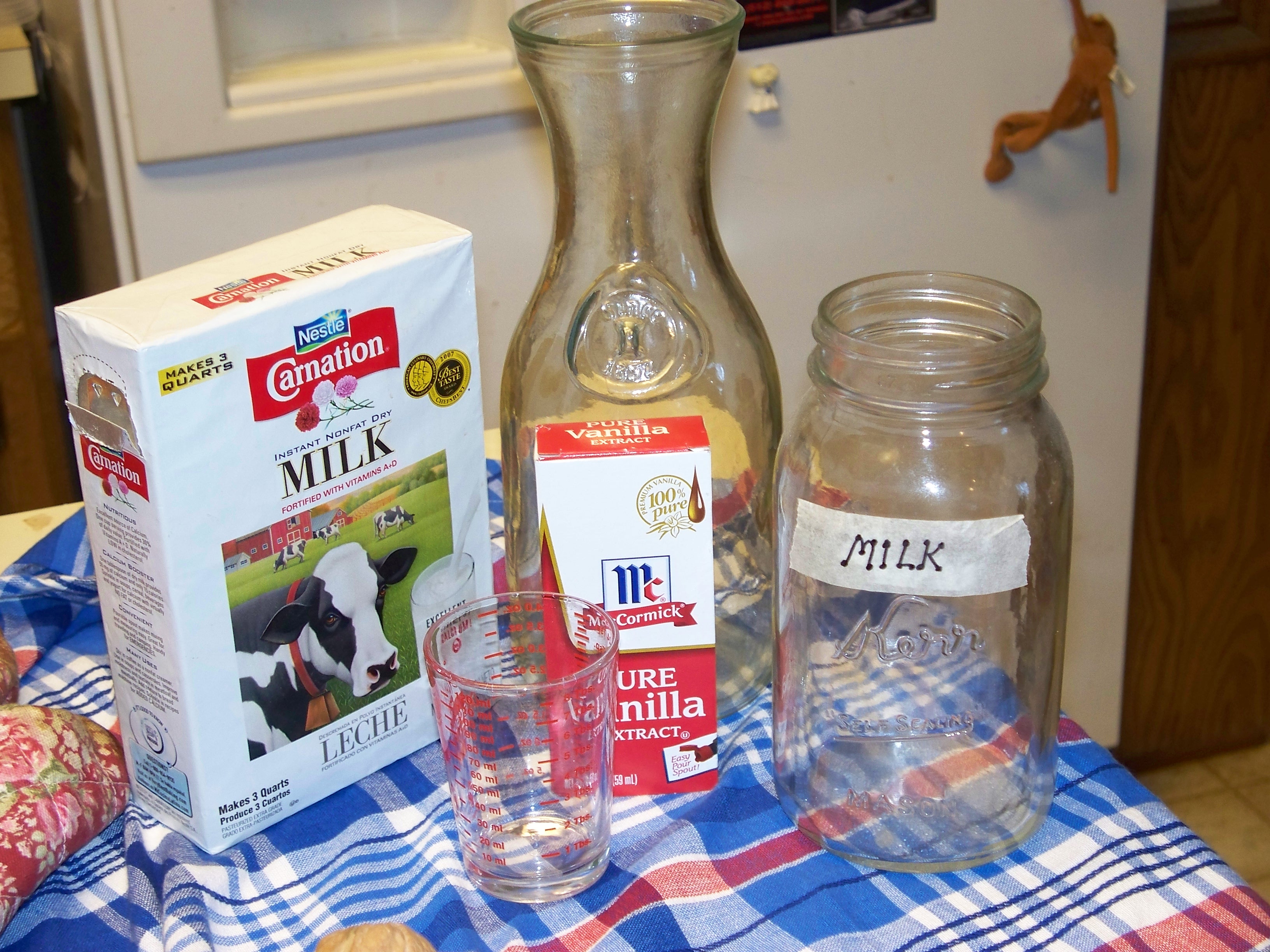
And now, on to Powdered Milk. I say that with initial caps because it is once again become a more popular alternative to expensive, fresh milk. With the urge to ‘Go Green’ and stockpile necessities, people are having to learn all over again how to make do with things that have a shelf life instead of buying fresh at their grocer or market. One of the things I often laugh at is some people’s reaction to powdered milk. When I was young and living in the Middle East we most often only had the powdered milk instead of fresh. Growing up on farms as my parents did and living near to them when we children were small, we were accustomed to fresh=from-the-cow milk and homemade butter. Switching to powder was a nasty taste to us but mom tried her best to make it palatable. Although today’s powdered dairy products are much tastier than before, there are still some tips that can make it an easier adjustment for you.
If you are just trying to stretch out your milk, many people will use a combination of 1/2 powdered milk mixture and half whole milk. Or they will only use the powdered mix with their cooking, cereal, etc. If you are going whole hog and trying to drink the stuff, you can use several variations to make a tastier mix blend. Here is my Mom’s ‘secret’ recipe for the best tasting reconstituted milk.
First, sterilize your final glass storage containers. You can do this by dipping them in boiling water or simply using the heat dry on your dishwasher. There are long detailed and scientific reasons why glass works better, but that is not the discussion today. To me, it just tastes better coming from glass. I use carraffes [quart size] and mason jars.
To make one gallon of milk, mix into a small saucepan the following:
1 can of evaporated milk, 1/4 cup sugar and 1 teaspoon real vanilla. I DO use a sugar substitute myself but this works better if you use the real thing. Warm slightly but do NOT boil – just get it warm enough for the sugar to dissolve. Set aside. In a large container or bowl, follow the directions on your box of FRESH powdered milk [not one that has sat around for twenty years] using cool, fresh water. If your tap water has flavor or smell, you may want to consider boiling it first and cooling it down. Powdered milk seems to dissolve well in cool water. Combine the two mixes you have made and chill at least 4 hours before drinking. Store in glass containers.
If you are used to drinking skim milk already, you will soon adjust to powdered plain with no additives. With this mix, you get a fatter, sweeter tasting milk that will make it easier for children and long term whole milk drinkers to adapt with. You may want to start with this mix and cut back slowly to where you are only using powdered milk.
So experiment and find the mix you like. Start by using the reconstituted mix in recipes and gradually work into having your family drink the powdered mix. You will soon find it is quick and easy to use powdered milk instead of making a run to the store every time you run short.
My wishes to you for a Happy, prosperous and healthy New Year! Oh, and restful. Take a cue from my Labrador, Ruby. Grab your best pillows and comfort items and take a nap!
Posted in Daily Life, Middle Eastern Stories | Tagged: going green, Middle East stories, Powdered Milk, Whomp 'em biscuits | Leave a Comment »
Garden Bounty
Posted by Range Officer Rhonda on December 12, 2010
I’ve been cooking for quite a while today; my garden just didn’t know when to quit. Before the last freeze a week or so ago, we harvested over 100 green tomatoes and several pumpkins. Today, I cleaned and canned 3 quarts of tomatoes, made ghoulash, made soup, banana nut muffins, pumpkin bread and pumpkin pie.
 And I still have dozens of green tomatoes that will get used as they ripen and 6 more pumpkins to go! I served our ‘garden bounty’ dinner to my in-laws and sent them enough food home for two more meals. No w that’s cooking!
Posted in My gardens | Tagged: Green tomatoes, Pumpkin Pie | Leave a Comment »
 Rhonda's A 'Muse'-ing Rambles